The tools behind What We Carry
Human Thread
Signals across our shared humanity.
AI-assisted sensemaking tools that start from wherever your community is, work for you first, and keep every line tied to the person who said it.
How it works
Four steps. You decide at every one.
Real screens from an organizer’s room, in a test community made of public 2006 answers. There’s no new software to learn first: we set it up with you.
-
01
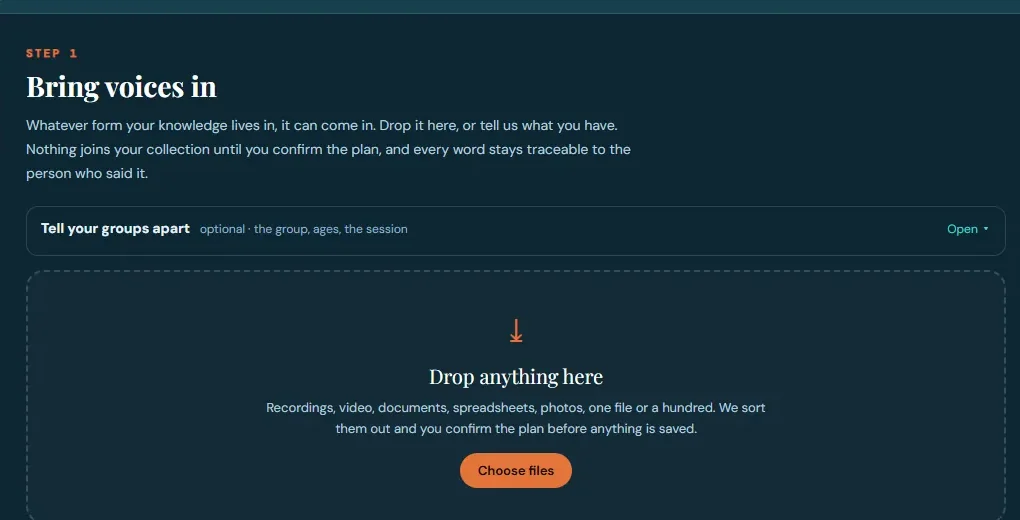
Bring what you know
Recordings, video, meetings, writing, in any language. One conversation or twenty years of tapes. It sorts it all, and nothing joins your collection until you say so.
-
02
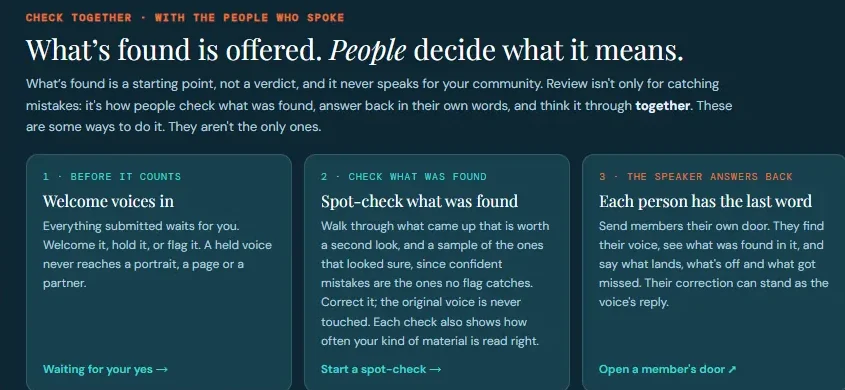
Check the first pass
Human Thread offers a first pass on what each voice says and what’s at stake. People check it, answer back in their own words, and have the last word.
-
03
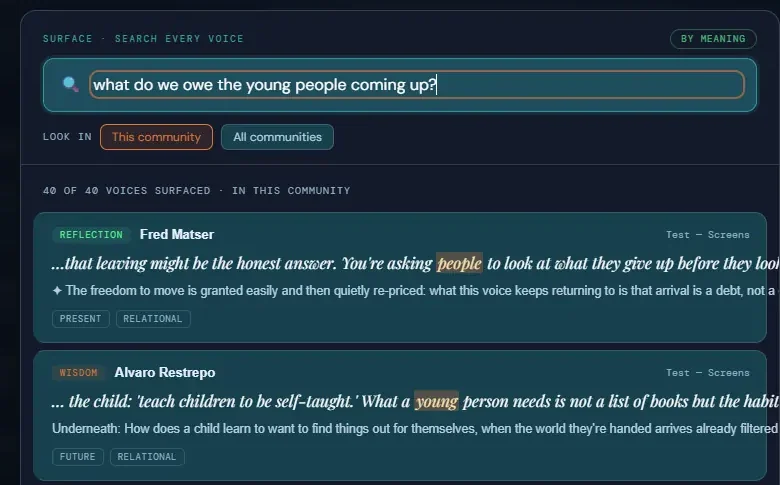
Find the threads
Ask in your own words and get people, not a summary. Voices gather by meaning, across languages and years, and every line leads back to the person who said it.
-
04
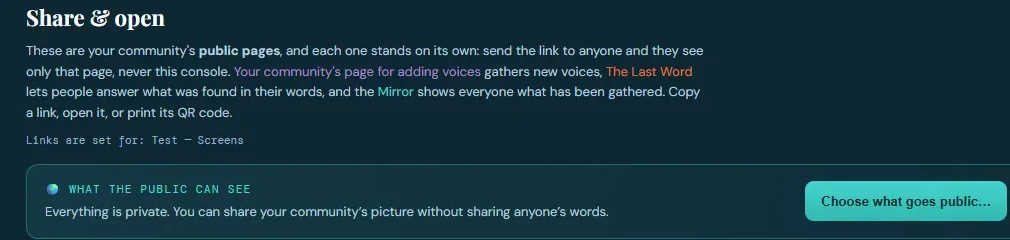
Share as much as you choose
Everything starts private. Open a little or a lot when you’re ready, and your community can take its place in What We Carry, beside the others.

Then put it to work
Knowledge that leaves the screen
For a classroom, a council meeting, a wall, a gathering. Each one is made from your community’s own voices, and points back to them.
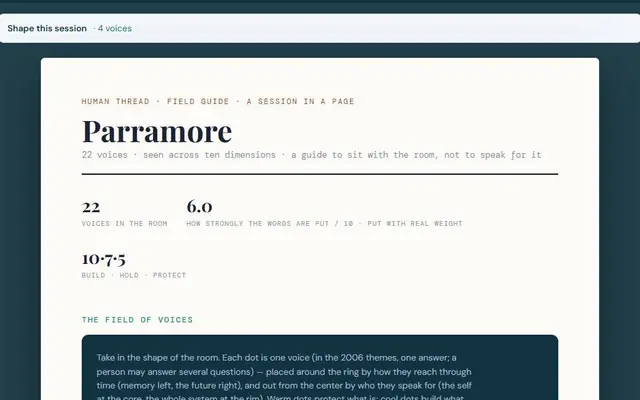 Field guidea session on one page
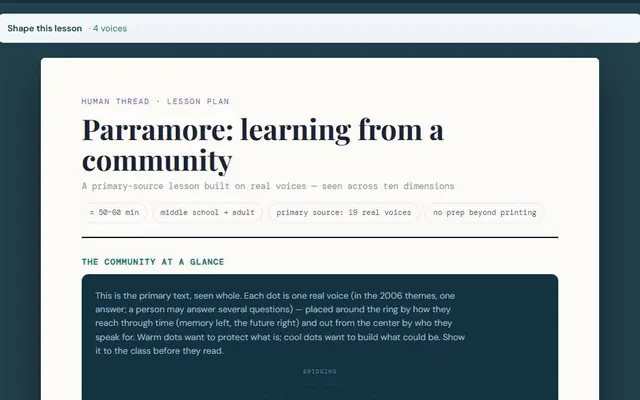 Lesson plana 50-minute class
 Exhibit kitwall panels with QR codes
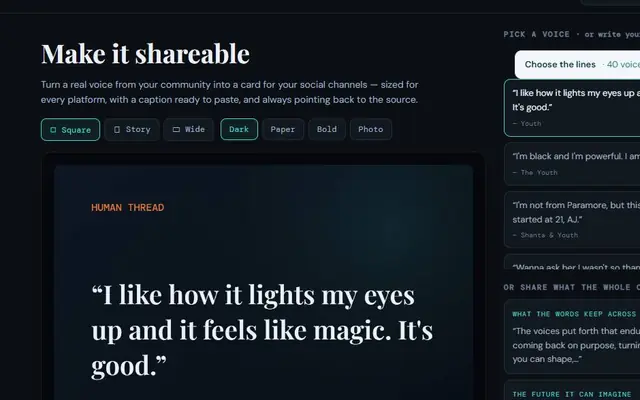 Social cardsa voice, ready to share
 The open seatany room can add to it
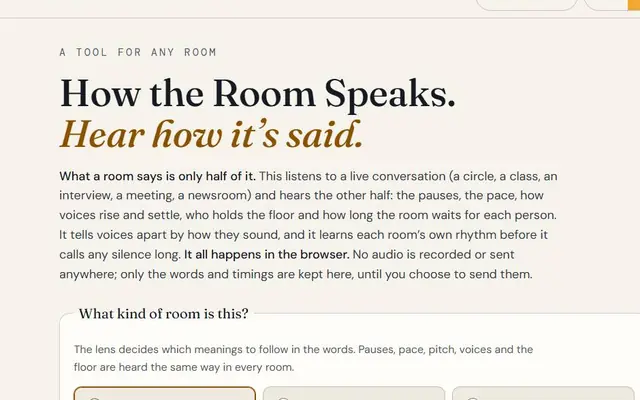 How the room speakswho held the floor
Also in the kit: decision briefs, letters to decision-makers, discussion cards, a zine, posters. See every tool ↗
Your knowledge stays yours
Cared for, in writing
- Private by default. Your space, under your key. Only the people you let in can see it.
- The AI works with what was said, not who said it. The link back to each person stays with you.
- Every line traces back. To the person and the moment it came from, word for word.
- Take it back any time. Download everything. Remove a voice, and it's removed.
- Open models, inside our own system. No outside AI company sees your voices.
- Protected from scraping. Built to keep AI crawlers from harvesting what communities share.
What if it gets something wrong?
What it offers is a first pass for people to check, never a verdict. Every line links back to the words and the moment they came from. People can affirm, refine or correct how they were understood, and a speaker's own correction stands.
How do you know it gets things right?
Everything it offers is checked against the person's own words, and the method is scored against an answer key of voices labeled by hand. It checks itself every morning and flags itself if it slips.
Does it ever put words in people's mouths?
No. Quotes are the person's own words, checked against what they said, and translated faithfully with the original kept. When no one speaks to a question, it says so instead of filling the gap.
Can someone take their words back?
Yes. Ask whoever holds your community's space, and they can set your words aside right away. They can come back later, or be removed for good. Can't reach them? Write to us and we'll help.
How do people add their voices?
Through doors your organizers make: a link that asks your question, a poster with a QR code, or screens at a gathering. Strangers can't add to your space.
What about young people?
When young people take part, the organizer handles consent first, including a guardian's consent for minors, before anything comes in.
Is this AI?
Yes. Human Thread is AI-assisted sensemaking: open models, running inside our own system, bring up and connect what people said. Nothing goes to an outside AI company. But it doesn't generate answers in anyone's voice. Every quote is the person's own words, and every line leads back to them.
Do we have to learn new software?
No. We bring things in with you and walk through what comes back together. The tools are there whenever you want to use them yourselves.
What languages does it work in?
The languages your community speaks. Voices in different languages can still find each other by what they mean.
Who can see our knowledge?
Only the people you let in. Nothing goes to another community or to the public unless you decide it should.
Want to use Human Thread with your community?
Tell us about your community and what you’d use it for: a class, a campaign, a meeting, a box of tapes. A real person writes back, and we’ll show you a first pass with your own voices.
Ask about the tools